Two GSE Filings, One Week: Rop Returns to the Sixth Circuit + Angel Files His Second Rule 59 Motion

If you're new here: I'm Glen Bradford. I'm long Fannie Mae and Freddie Mac junior preferred shares and have written the full Fanniegate thesis for years. This post covers two procedural filings that arrived four days apart in different federal courts. Neither is the main event — the D.C. Circuit Berkley appeal heard April 21 is. But both are worth tracking, and both are now hosted in full at the bottom of this post.
The two filings:
-
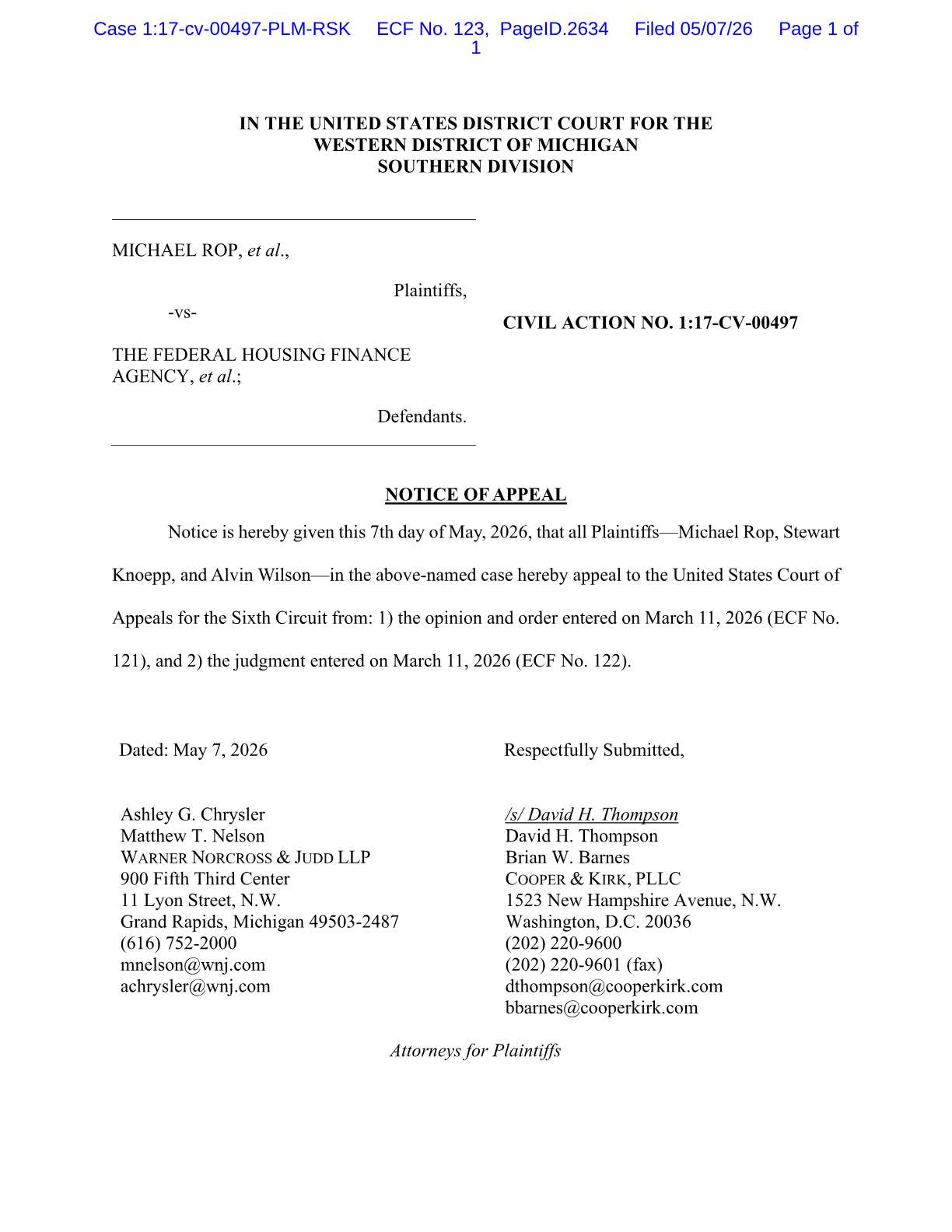
Rop v. FHFA — Notice of Appeal, filed May 7, 2026 in the Western District of Michigan (Case 1:17-cv-00497-PLM-RSK, Dkt #123). All three Plaintiffs — Michael Rop, Stewart Knoepp, and Alvin Wilson — appeal Judge Paul Maloney's March 11, 2026 Opinion and Order (Dkt #121) and Judgment (Dkt #122) to the U.S. Court of Appeals for the Sixth Circuit. This is Rop's second trip to the Sixth Circuit. Cooper & Kirk (David H. Thompson, Brian W. Barnes) is back on the brief alongside Warner Norcross & Judd — and Brian Barnes is the same lawyer who argued the Berkley cross-appeal at the D.C. Circuit sixteen days earlier. One firm. Two parallel tracks. Two different doctrines.
-
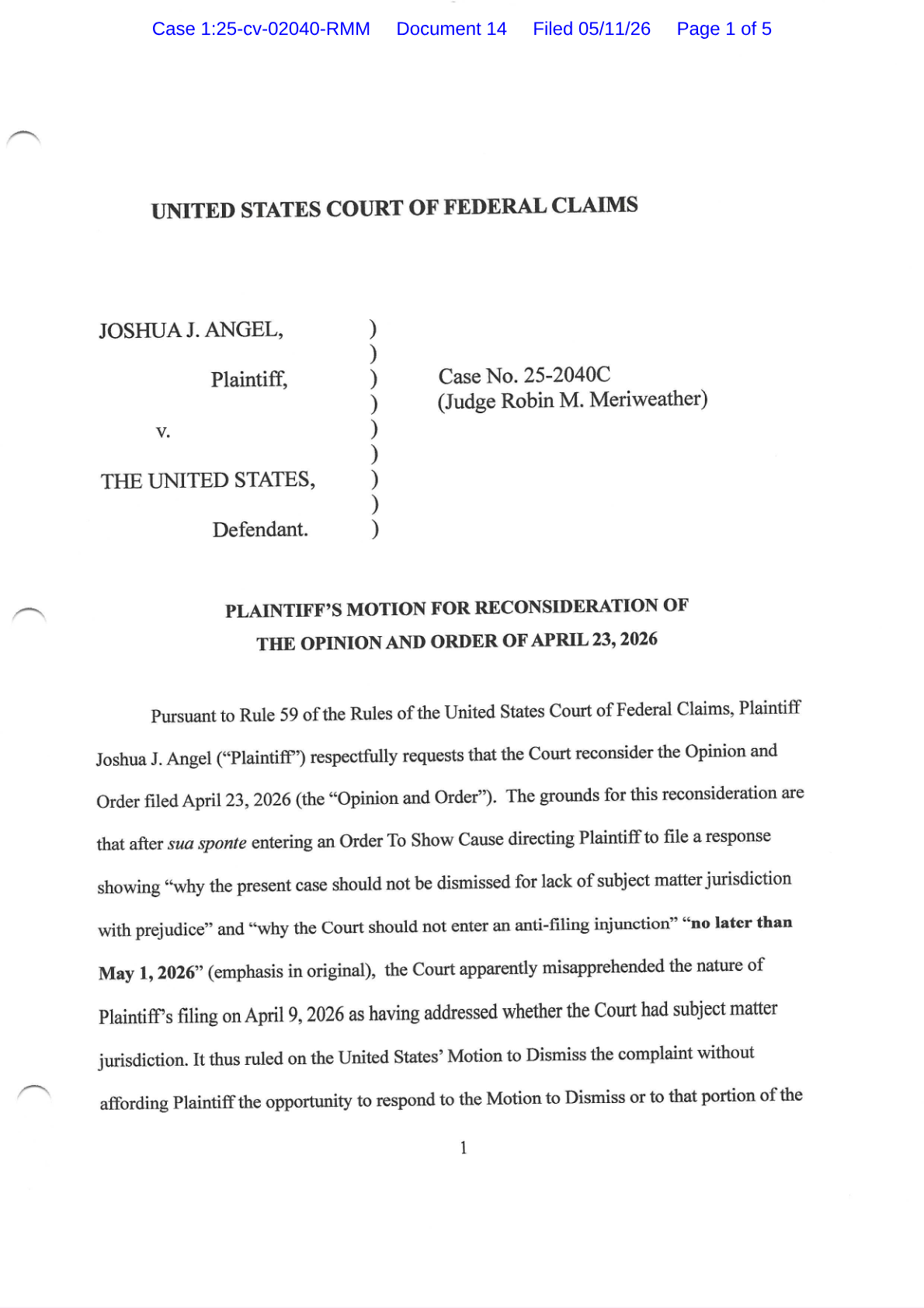
Angel v. United States — Second Motion for Reconsideration, filed May 11, 2026 in the U.S. Court of Federal Claims (Case 25-cv-2040-RMM, Dkt #14). Joshua J. Angel, pro se with Prof. David G. Epstein "Of Counsel," asks Judge Robin M. Meriweather to vacate her April 23, 2026 Opinion and Order dismissing the case with prejudice and entering an anti-filing injunction. This filing supersedes Angel's first motion for reconsideration (Dkt #13, filed April 27), and it brings a sharper, more focused argument under RCFC 59.
Both filings are linked below in full, with page-1 screenshots, for anyone who wants the primary source.
Rop v. FHFA — Round Two at the Sixth Circuit
What just got appealed
Judge Maloney's March 11 ruling granted FHFA's and Treasury's motions for judgment on the pleadings and denied the Rop Plaintiffs leave to file a second amended complaint. Two appealable orders, one notice — Dkts 121 and 122. The Plaintiffs took the maximum 30 days. Notice of appeal hit on day 57 of the post-judgment window, well within the Fed. R. App. P. 4(a)(1)(B) 60-day clock that applies when the United States is a party.
The Collins-harm framework — what the Sixth Circuit will actually decide
The Sixth Circuit already heard Rop once. In October 2022 (No. 20-2071), it ruled (A) Acting Director DeMarco was not serving in violation of the Appointments Clause when he signed the Third Amendment, and (B) the case must be remanded to the District Court to determine whether the unconstitutional removal restriction inflicted harm on shareholders. That harm-on-remand standard comes straight out of Collins v. Yellen — the Supreme Court's 2021 ruling that left a narrow theoretical opening for shareholder challenges: if the President wanted to fire an FHFA Director and was blocked by the for-cause removal restriction, that could be a cognizable injury.
Every Circuit to address that narrow opening has now closed it:
- Fifth Circuit: Collins v. Dept. of Treasury, 83 F.4th 970 (5th Cir. 2023) — dismissed
- Eighth Circuit: Bhatti v. FHFA, 97 F.4th 225 (8th Cir. 2024) — dismissed
- Federal Circuit: Fairholme Funds v. United States, 26 F.4th 1274 (Fed. Cir. 2022) — dismissed
- Western District of Michigan (Rop on remand): dismissed March 11, 2026
The Plaintiffs' best card has always been Trump's November 2021 letter to Senator Rand Paul — written after his first term ended — stating that he "would have fired" former Director Mel Watt and ordered the GSEs released from conservatorship. Maloney was unmoved: the letter was post-presidency, it was sent privately to a Senator (not a public statement of the kind Collins requires), and most of the contemporaneous Trump-era statements in the complaint were policy aspirations, not specific plans to remove a Director.
Why this isn't crazy — the standard of review is friendlier on round two
A lot of readers will see "second appeal" and assume Cooper & Kirk is desperate. The standard-of-review math says otherwise.
Maloney's March 11 order combined two rulings: (a) denial of leave to amend on futility grounds and (b) grant of judgment on the pleadings under Rule 12(c). Both get de novo review at the Sixth Circuit — leave-to-amend denials usually get abuse-of-discretion, but futility-based denials are reviewed as a legal question. That's the only reason this appeal is worth filing on the merits. The Sixth Circuit doesn't have to defer to a word of what Maloney said about the Trump statements.
What Cooper & Kirk has to do at the Sixth Circuit
Three angles I'm watching:
-
Distinguish the other Circuits. Fairholme (Federal Circuit) was takings-clause; Collins (Fifth Circuit on remand) and Bhatti (Eighth Circuit) both rejected harm theories but on their own records. Rop has the Rand Paul letter as a specific factual record point. The Cooper & Kirk move is to argue Maloney applied too strict a "public statement contemporaneous to a removal attempt" gloss that Collins itself doesn't require.
-
Press the leave-to-amend denial on the new factual record. Trump's May 27, 2025 "implicit GUARANTEES" Truth Social post — the same statement that anchors Angel V — is a contemporaneous, public, second-term statement that didn't exist when Maloney first set the scheduling order. If the Sixth Circuit credits that as a Collins-qualifying statement, the futility ruling falls apart.
-
Threading between Berkley and Collins. The D.C. Circuit panel that heard Berkley on April 21 appeared to credit the implied-covenant theory at oral argument. That is a completely different doctrinal track from Rop's removal-restriction theory — Berkley is state-law contract; Rop is constitutional damages. A plaintiff-friendly Berkley ruling doesn't legally bind the Rop panel. But it creates the atmospheric reality that some federal judges are willing to find against the government on the Net Worth Sweep. That matters more than people admit.
-
The circuit-split insurance. If any Sixth Circuit panel reverses on the futility ruling alone — even just to remand for an evidentiary hearing on whether Trump's 2025 statements satisfy Collins — that's a circuit split with the Fifth and Eighth. A circuit split is what gets the Supreme Court back into Fanniegate. Cooper & Kirk is the same firm that argued Collins at SCOTUS. They know exactly what they're stitching toward.
Realistic timeline
Sixth Circuit briefing for a civil appeal of this density: record on appeal transmitted within 30-60 days; appellants' opening brief 40 days after the record (likely late July 2026); FHFA and Treasury answer briefs filed separately 30 days later (likely late August 2026); reply brief 14-21 days after that (likely mid-September 2026). Oral argument calendars 4-8 months after briefing closes (likely spring-to-summer 2027). Opinion drops 3-12 months after argument — realistically late 2027 to mid-2028.
That is a long horizon. The optionality here is insurance, not catalyst. The Berkley D.C. Circuit opinion is the near-term mover (expected July 2026 – January 2027). Rop won't have material movement until well after Berkley resolves.
The first Rop appeal panel (No. 20-2071) was Judges Gibbons, Cook, and Thapar — Thapar had recused at the district level back in 2016 because his wife owned sixteen shares of Fannie Mae stock. The Sixth Circuit does not follow a strict same-panel-on-remand rule. A second appeal arising from the same case is treated as a fresh draw — there's no entitlement to the same judges, though there's nothing prohibiting overlap.
What this filing actually signals
Cooper & Kirk doesn't burn time on hopeless appeals at this stage. The decision to file the Notice of Appeal close to the maximum-allowed day suggests the firm wanted runway to evaluate whether the Berkley D.C. Circuit panel signaled enough plaintiff-friendly atmospheric to be worth the second-appeal effort. They decided yes. That's a real datapoint, even if you discount it for the firm's existing investment in the case.
I closed my March 12 post on the dismissal with "the path forward is not in courtrooms." Cooper & Kirk just contradicted that conclusion in real time by filing this notice. I'm not retracting the broader claim — the real recapitalization comes from FHFA/Treasury policy, not from a Sixth Circuit panel — but the litigation track isn't quite as closed as I wrote it.
Angel v. United States — The Procedural Due-Process Card
What the Second Rule 59 Motion actually argues
The previous motion (Dkt #13, filed April 27) made four points — DOJ's misattribution of Angel I, the eleven-month Trump-tweet timing error, the non-merits dismissals of Angel II and III, and the cancelled response window. The May 11 motion drops most of that and goes straight to the procedural-due-process card.
The argument, in one paragraph: Judge Meriweather entered her dismissal Opinion and Order on April 23 — seven days before the May 1 response deadline she herself had set in two prior orders (the March 2 Minute Order and the April 3 sua sponte Order to Show Cause). She did so by treating Angel's April 9 filing (Dkt #10) as if it were a substantive opposition to DOJ's Motion to Dismiss. It wasn't. It was almost entirely about settlement posture and an extension request. Angel never had a meaningful chance to brief the jurisdictional and statute-of-limitations questions before the court ruled against him on those very issues.
The two-case backbone
Angel's lead authority is ArthroCare Corp. v. Smith & Nephew, 406 F.3d 1365 (Fed. Cir. 2005) — for the principle that, even when not strictly required, a court that sets a schedule should not alter it sua sponte and issue a binding decision on the merits without giving an adversely affected party "a meaningful opportunity to be heard."
He pairs it with Allen v. United States, 88 F.4th 983 (Fed. Cir. 2023) — conceding the CFC can dismiss for lack of subject-matter jurisdiction sua sponte in appropriate circumstances, but arguing this isn't one of those circumstances. The court had affirmatively scheduled briefing, issued an Order to Show Cause with a specific May 1 deadline, and then collapsed both tracks into a dismissal a week early without warning.
Why this is the strongest argument Angel had
RCFC 59 — the CFC's reconsideration rule — parallels Fed. R. Civ. P. 59 and requires the movant to show either an intervening change in controlling law, newly discovered evidence, or the need to correct a clear error of law or fact, or to prevent manifest injustice. Procedural due process — being deprived of a briefing window the court itself set — fits squarely into the third prong. It is a colorable manifest-injustice theory in a way that "the court mis-characterized the tweet timeline" arguably isn't.
The hard counter: even if the court erred procedurally, Angel needs to show that the substantive opposition he would have filed would have moved the needle on the jurisdictional question. The government's position — that the claims accrued in 2013 with the Net Worth Sweep and the six-year Tucker Act statute of limitations expired in 2019 — is one Angel has lost on three times already. Procedural due-process arguments are easier to credit when the substantive merits aren't already a wall.
David Epstein's signature matters more than you'd think
David G. Epstein is "Of Counsel" — Professor at Richmond Law, a nationally recognized authority on bankruptcy, commercial law, and the UCC. His presence on the filing matters because Count III of Angel V sought declaratory relief under 11 U.S.C. § 1124 — a Bankruptcy Code provision — arguing the junior preferreds are "permanently impaired" and therefore mandatorily redeemable at $34B face plus interest. That's an unusual cross-doctrinal theory, and Epstein is the kind of academic who lends it credibility even when Angel litigates pro se as a CFC bar member. His name on the May 11 filing is a signal that the team isn't pulling back.
The anti-filing injunction stays in effect either way
Whatever Judge Meriweather does with the Rule 59 motion, the anti-filing injunction remains in effect through the appeal. Even a partial vacatur of the merits dismissal would still leave the injunction in place absent a separate ruling on it. This is realistically Angel's last meaningful bite at the CFC apple. As I wrote on the hub page: if FHFA and Treasury actually file a conservatorship-termination proposal in 2026, the implicit-guaranty argument may be resurrected — but by other plaintiffs in other cases, not by Angel.
Both Tracks in One Frame
I want to step back. There are three live shareholder cases that matter right now and each is on a different doctrinal axis. Here's the table I keep in my head:
| Case | Theory | Court | Posture | My read | |------|--------|-------|---------|---------| | Berkley / Class | Implied covenant of good faith (won at trial, $812M jury verdict) | D.C. Circuit (No. 25-5113) | Awaiting opinion after April 21, 2026 oral argument | Bullish-leaning — Walker pressed FHFA hard | | Rop | Collins removal-restriction harm | Sixth Circuit (second appeal) | Just appealed May 7, 2026 | Steep climb. Every Circuit has closed this door. The win is preserving the doctrine, not winning the case. | | Angel V | Implicit-guaranty + Bankruptcy Code impairment | Court of Federal Claims | Rule 59 motion pending | The procedural-due-process argument is the strongest card, but the substantive merits wall is high |
The bull case for shareholders doesn't depend on Rop or Angel winning. It depends on Berkley winning at the D.C. Circuit and the FHFA / Treasury releasing the GSEs from conservatorship at par or near it. Rop and Angel are sideshows in terms of dollar impact, but they're historically important — they're the procedural record of what the courts have or haven't been willing to do to address a $300B+ government extraction. I host them, I summarize them, and I keep them findable.
If you have to pick one track to actually watch: it's Berkley. If you're a completionist who wants the full history: hit the Fanniegate Timeline and the Joshua Angel case tracker.
The Filings
Rop Notice of Appeal — Dkt #123, filed May 7, 2026
Download PDF — 17-cv-00497-0123 (1 page)
Angel Second Motion for Reconsideration — Dkt #14, filed May 11, 2026
Download PDF — 25-2140-0014 (5 pages)
What I'm Doing
Nothing new. I've been long FNMA and FMCC junior preferred shares for years and these two filings don't change my position. Neither Rop nor Angel V moves enough probability mass to justify trading around it. The real catalyst remains:
- Berkley D.C. Circuit opinion — expected July 2026 to January 2027
- FHFA / Treasury announcement on termination — political timing, not legal timing
- Trump administration GSE policy — Bessent has been making noises; nothing concrete
I'll keep hosting filings as Peter Chapman mails them. That's the public service. The full thesis stays at glenbradford.com/fanniegate.
If You Want to Go Deeper
- Full Fanniegate thesis — the whole story
- Joshua Angel v. United States — Pro Se Case Tracker — Angel I through Angel V, with Rule 59 arguments cataloged
- D.C. Circuit oral argument recap (April 21, 2026) — the real main event
- Rop v. FHFA Dismissed — Judge Maloney's March 11 opinion — what's being appealed
- Angel v. United States (May 5 post) — the first motion for reconsideration
- Fanniegate Timeline — interactive 16-milestone history
- Fannie/Freddie Shareholder Lawsuits — Survey — every major case in one place
I hold long positions in Fannie Mae and Freddie Mac junior preferred shares. This post is my personal opinion and is not legal or financial advice. I am not a lawyer. Filings are hosted in full so you can read them yourself. Do your own research. The full thesis is at glenbradford.com/fanniegate.
Free Tools & Calculators
Interactive tools built by Glen Bradford
Enjoyed this? Get more like it.
Glen's Musings — AI, investing, and building things. Occasional. Free.

Glen Bradford
Investor · Builder · Writer
MBA from Purdue. Former hedge fund manager. Holds 26 series of Fannie Mae and Freddie Mac junior preferred stock. Built Cloud Nimbus for Salesforce consulting. Author of Act As If. Writes about investing, building things, and the longest financial fraud in American history.
More in Fanniegate
Keep Exploring
FNMA Stock Forecast & Analysis
What actually drives Fannie Mae stock — catalysts, restructuring math, and honesty.
Read moreNEWGSE Catalyst Tracker
Track every signal toward Fannie & Freddie privatization
Read moreNEWFannie Mae Preferred Dividends
Every series, coupon rate, suspension status, and yield math if dividends resume.
Read moreNEWFannie Mae vs Freddie Mac
Side-by-side comparison — and why it doesn't matter for investors.
Read moreNEWBest Preferred Stocks to Buy
26 series Glen actually owns — with coupon rates, par values, and reasoning.
Read moreFanniegate Timeline & Evidence
The full timeline, 8 books, and the current status of recapitalization.
Read moreTrading Analysis — 4 Years of Data
Every trade, every ticker, every price. 2,068 transactions parsed and visualized.
Read moreHow to Buy Preferred Stock
Step-by-step guide from an investor who owns 26 series.
Read moreDisclaimer: This blog post reflects the author's personal opinions at the time of writing and is not financial, investment, or legal advice. Glen Bradford holds positions in securities discussed on this site. Past performance is not indicative of future results. Do your own research and consult qualified professionals before making investment decisions. Some content on this site was generated or edited with AI assistance.