Two Opening Briefs, Four Days Apart: Rop at the Sixth Circuit, Angel at the Federal Circuit

If you're new here: I'm Glen Bradford. I'm long Fannie Mae and Freddie Mac junior preferred shares and have written the full Fanniegate thesis for years. I also host the primary-source filings so anyone can read them without a PACER account. This is one of those posts. Both briefs are linked in full at the bottom.
Two shareholder opening briefs landed four days apart in two different federal appellate courts:
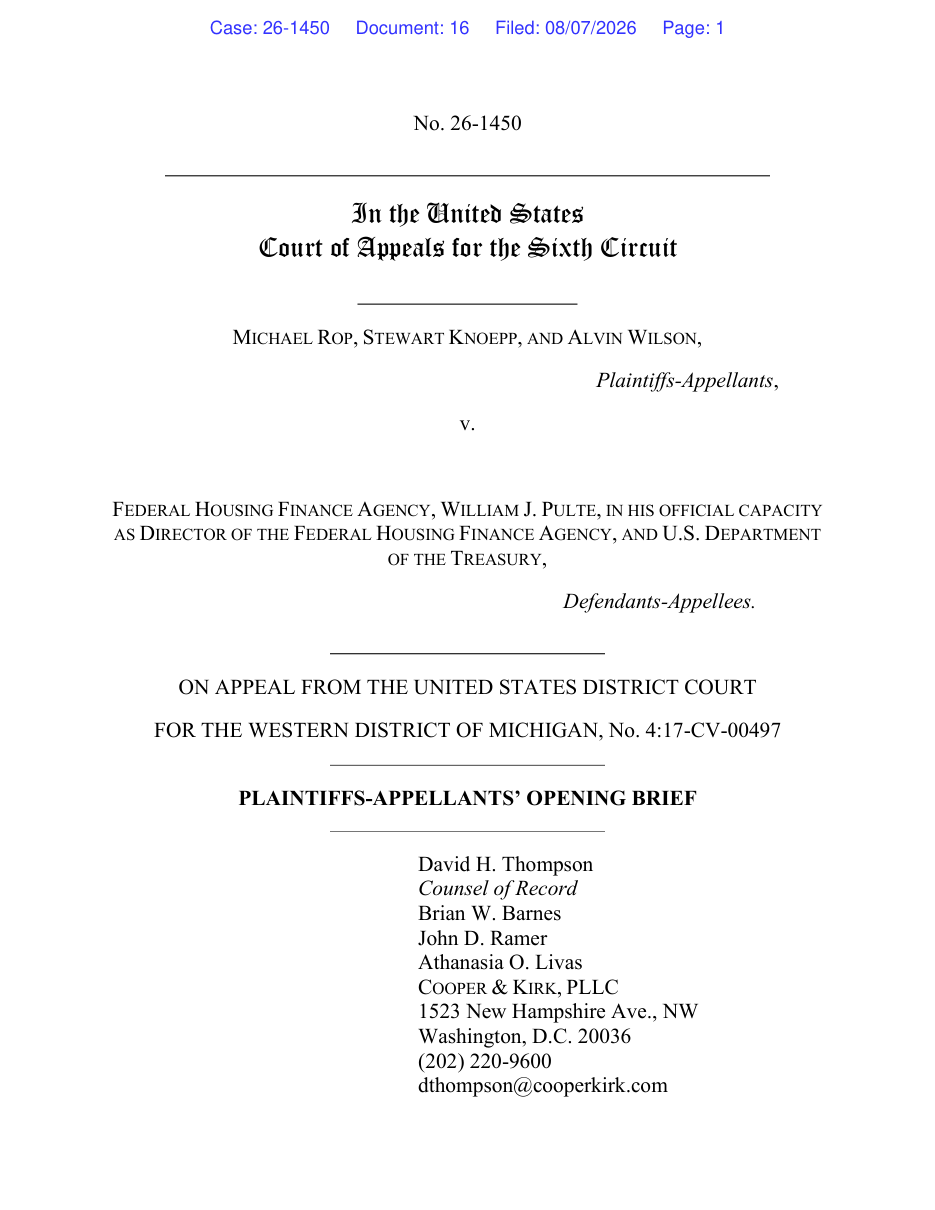
- Rop v. FHFA — Plaintiffs-Appellants' opening brief, filed August 7, 2026, U.S. Court of Appeals for the Sixth Circuit, No. 26-1450, Document 16. Cooper & Kirk on the brief.
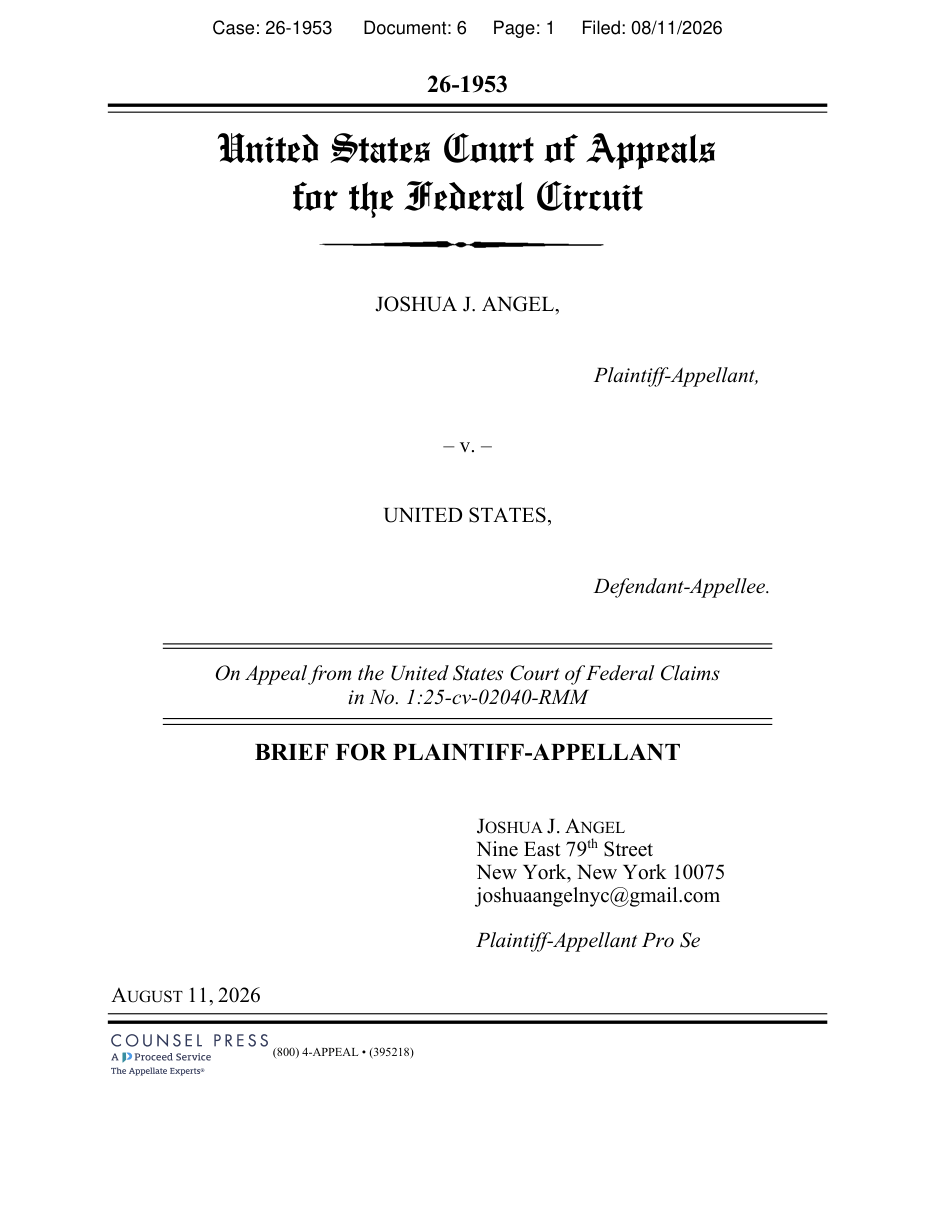
- Angel v. United States — Brief for Plaintiff-Appellant, filed August 11, 2026, U.S. Court of Appeals for the Federal Circuit, No. 26-1953, Document 6. Joshua J. Angel, pro se.
They are unrelated cases with unrelated legal theories. They are being litigated by opposite ends of the resource spectrum — one of the best appellate shops in the country on one side, a lawyer representing himself on the other. And they just made the same structural move within four days of each other.
Both briefs are built on a Trump statement being treated as a fact that changes the legal analysis. Rop's is the November 11, 2021 letter to Senator Rand Paul. Angel's is the May 27, 2025 "implicit GUARANTEES" post. In each case the argument is not "the government behaved badly" — it's "here is a specific statement by the President, on the record, that supplies the exact element the court said was missing."
That's the through-line. Here's what each brief actually says.
1. Rop v. FHFA — Sixth Circuit, No. 26-1450
Where the case stands
Rop has been running since 2017 in the Western District of Michigan (No. 4:17-cv-00497). Plaintiffs Michael Rop, Stewart Knoepp, and Alvin Wilson are individual GSE shareholders. Defendants are FHFA, William J. Pulte in his official capacity as Director, and Treasury.
The case has already been to the Supreme Court as a companion to Collins v. Yellen, 594 U.S. 220 (2021), and already been to the Sixth Circuit once (No. 20-2071, October 2022), which sent it back down for the narrow purpose of deciding whether the unconstitutional removal restriction actually harmed shareholders.
On March 11, 2026, Judge Paul Maloney granted FHFA and Treasury judgment on the pleadings and denied leave to file a Second Amended Complaint. Final judgment entered. Notice of appeal May 7, 2026. This brief is the merits swing.
On the cover of this brief: counsel of record David H. Thompson, with Brian W. Barnes, John D. Ramer, and Athanasia O. Livas of Cooper & Kirk, PLLC — the same shop, and in Barnes's case the same lawyer, carrying the D.C. Circuit Berkley cross-appeal. They've requested oral argument.
The two issues presented
- Whether the district court abused its discretion in denying leave to amend for lack of "good cause" under Rule 16(b)(4).
- Whether the district court erred in granting judgment on the pleadings under Rule 12(c) and denying leave to amend as futile.
Standards of review matter here more than usual, so read them carefully before you get excited: denial of leave to amend is reviewed for abuse of discretion, but a denial on futility grounds is reviewed de novo, and Rule 12(c) dismissals are reviewed de novo. Leary v. Daeschner, 349 F.3d 888, 904 (6th Cir. 2003). Both of the district court's substantive holdings run through the 12(b)(6) standard, and the Sixth Circuit gets to look at those fresh with no deference.
The Collins hypothetical, and the letter
Here's the passage the whole appeal orbits. In Collins, the Supreme Court declined to specify a remedy and instead described situations where the removal restriction "would clearly cause harm." One of them:
"suppose that the President had made a public statement expressing displeasure with actions taken by a Director and had asserted that he would remove the Director if the statute did not stand in the way."
Collins, 594 U.S. at 260.
The Plaintiffs' answer to that is a signed letter from President Trump to Senator Rand Paul, dated November 11, 2021 — written after the Collins decision came down, and expressly responding to it. Trump acknowledges the Court "asks what I would have done had I controlled FHFA from the beginning of my Administration, as the Constitution required," and then answers:
"From the start, I would have fired former Democrat Congressman and political hack Mel Watt from his position as Director and would have ordered FHFA to release these companies from conservatorship. My Administration would have also sold the government's common stock in these companies at a huge profit and fully privatized the companies. … My Administration was denied the time it needed to fix this problem because of the unconstitutional restriction on firing Mel Watt."
The brief's position is blunt: Collins said a statement like that would "clearly" show harm, the President made exactly that statement, and "[t]hat fact alone precludes dismissal for failure to state a claim."
What Maloney held, and how the brief answers it
This is the live tension, and it's why this appeal is more interesting than the usual post-Collins cleanup.
Judge Maloney was not persuaded by the letter. Per the brief, he discounted it by requiring that a presidential statement be public and contemporaneous, and by separately requiring Plaintiffs to plead that the Trump Administration had "specific plans to achieve" its stated goals.
Cooper & Kirk's answers:
- On "public": the letter was publicized — it ran on RealClearPolitics and is preserved at a perma.cc link cited in the brief. Whatever the requirement is, a letter published on a national news site meets it.
- On "contemporaneous": the requirement "makes no sense." Trump is describing a counterfactual that only became legally relevant when Collins issued — after he left office. Under the district court's logic, "a sitting President would have to make a public, contemporaneous statement for every action he would like to take but cannot take because of some limitation on his authority," with no prior notice that this was required. The brief calls that "an exercise in absurdity."
- On "specific plans": that requirement "is found nowhere in the Supreme Court's Collins decision or in any other relevant authority."
- On the procedural posture: a Rule 12(c) motion tests the sufficiency of allegations, not "the admissibility or final evidentiary weight of the proof." The district court "chose to disbelieve a former President of the United States" at the pleadings stage.
And the line that will get quoted: "To the extent the district court nevertheless found the framework too speculative, that is a quarrel with the Supreme Court's holding in Collins, not with the sufficiency of plaintiffs' allegations."
The burden-shifting ask
If there's any residual uncertainty, the brief argues the burden should flip to the government — because the non-public facts about what the Administration would have done live exclusively with Defendants and their current and former officers. It leans on Concrete Pipe, 508 U.S. 602, 626 (1993), Gomez v. Toledo, 446 U.S. 635 (1980), and the McDonnell Douglas prima-facie framework.
That's an ambitious ask on a pleadings appeal. It's also a tell about how the brief is hedged: primary argument is that the letter is dispositive; fallback is that at minimum the case should survive to factual development.
Treasury doesn't save the government
The brief closes by handling Justice Kagan's partial dissent in Collins — the argument that the President's at-will removal power over the Treasury Secretary means the FHFA removal restriction couldn't have harmed anyone. The response: that may have force as to adopting the Net Worth Sweep, which Treasury could have vetoed, but it has no force as to Director Watt's decision to maintain the status quo rather than position the companies to exit conservatorship. Treasury could not unilaterally amend the Third Amendment, and Treasury could not make Watt move.
The underlying numbers, as recited from the complaint: the Companies paid Treasury roughly $300 billion — Fannie $181B, Freddie $119B — about $109 billion more than they ever drew.
2. Angel v. United States — Federal Circuit, No. 26-1953
Where the case stands
Joshua J. Angel is a junior-preferred holder who has now filed five complaints across two courts. I keep the full Angel I–V procedural history here.
Angel V was filed in the Court of Federal Claims on December 1, 2025 (No. 1:25-cv-02040-RMM). On April 23, 2026, Judge Robin M. Meriweather dismissed it with prejudice for lack of subject-matter jurisdiction on statute-of-limitations grounds, and ordered the Clerk to enjoin Angel from filing new documents in that court without leave from the Chief Judge. Judgment entered April 24. Angel filed his notice of appeal June 15, 2026; the court denied his second motion for reconsideration June 16.
One thing worth being precise about: the anti-filing injunction is scoped to the Court of Federal Claims. By its terms it bars new filings in that court without leave of the Chief Judge. It does not bar this appeal, which is docketed and now briefed at the Federal Circuit.
The brief is 21 pages, written and signed by Angel himself, with the dismissal opinion attached as an addendum.
The single issue on appeal
This is narrower than people are going to assume. The issue presented is whether the Court of Federal Claims erred in dismissing for lack of subject-matter jurisdiction on limitations grounds without substantive briefing from Angel, because of the show-cause procedure the trial court used.
The procedural story: the government moved to dismiss. Angel never responded to that motion. Instead, on April 3 the court sua sponte issued an Order to Show Cause giving him until May 1 to explain why the case shouldn't be dismissed and why an anti-filing injunction shouldn't issue. On April 9 Angel moved for more time — which he says the court misread as his substantive response. The court dismissed on April 23 — before the May 1 deadline it had itself set.
The conclusion asks the Federal Circuit to vacate the Opinion and Order and the Judgment in full and remand — which would sweep in the injunction — but the issue actually presented for review is the limitations/procedure question.
The claim: quarterly dividend determinations, not the sweep
Angel is careful, repeatedly, to say he is not challenging the Third Amendment or the Net Worth Sweep. That distinction is the entire appeal.
His theory: the certificates of designation for the junior preferred are express contracts governed by Virginia (Fannie) and Delaware (Freddie) corporate law, and they obligate each board to make a reasonable, good-faith determination every fiscal quarter about whether to declare a dividend. Not to pay one — to decide. He quotes Folk on the Delaware General Corporation Law for the proposition that the business judgment rule "has no role where the directors have either abdicated their functions, or absent a conscious decision, failed to act."
The government, through the conservatorship, prevented the boards from making that determination each quarter. Declaring a dividend and deferring payment until after conservatorship, he argues, would have preserved his rights without interfering with the sweep at all — the Third Amendment "allowed, but did not mandate the quarterly decisions to not even declare dividends."
Counts: Count I breach of contract, ~$12 billion in junior preferred dividend entitlement; Count II illegal exaction and extraction of that same ~$12 billion plus ~$16 billion of litigation proceeds swept to Treasury. (Those are the Angel V figures. Earlier Angel complaints pleaded different numbers — don't mix them.)
To be clear about what these shares are: the junior preferred are non-cumulative. The "would accumulate and be paid after the Companies exited the conservatorships" language in the brief is describing his declare-and-defer theory, not a claim that missed dividends automatically stack up.
The limitations argument: continuing claims
The Court of Federal Claims has a hard six-year jurisdictional limit, 28 U.S.C. § 2501. Judge Meriweather held the Net Worth Sweep was the "single distinct event" that started the clock, which ran out in 2019 — so the December 2025 complaint was too late.
Angel's response is the continuing claims doctrine: where a claim is "inherently susceptible to being broken down into a series of independent and distinct events or wrongs, each having its own associated damages," each breach accrues separately. Brown Park Estates-Fairfield Dev. Co. v. United States, 127 F.3d 1449, 1456 (Fed. Cir. 1997); Boling v. United States, 220 F.3d 1365, 1373 (Fed. Cir. 2000).
His anchor case is Hatter v. United States, 203 F.3d 795 (Fed. Cir. 2000) (en banc) — federal judges challenging Medicare deductions from their salaries. The government argued the claim accrued when the statute passed. The Federal Circuit held each paycheck deduction was a separate injury with its own limitations clock. Angel's analogy: each quarter the boards were blocked from making a dividend determination is a fresh breach of an ongoing duty, and the ones after December 1, 2019 are timely. He isn't trying to revive the old ones.
On Fairholme Funds v. United States, 26 F.4th 1274 (Fed. Cir. 2022) — the case the trial court relied on — he distinguishes it directly: Fairholme challenged the legality of the Third Amendment itself, so of course that claim accrued in 2012. Whether the quarterly board determinations are separate accrual events "was not raised in or considered by the Fairholme court." He also notes the trial court cited no decision holding those quarterly decisions aren't distinct events, and made no factual findings at all.
The Trump post
The other pillar. On May 27, 2025, Trump posted:
"Our great mortgage agencies, Fannie Mae and Freddie Mac, provide a vital service to our Nation by helping hardworking Americans reach the American Dream – Home Ownership. I am working on TAKING THESE AMAZING COMPANIES PUBLIC, but I want to be clear, the U.S. Government will keep its implicit GUARANTEES, and I will stay strong in my position on overseeing them as President."
Angel's argument is that whether the federal government implicitly guaranteed the GSEs' obligations "may at one point have been subject to question" — and after that post, it isn't. Prior courts treated his implicit-guaranty theory as implausible. He says the President just made it explicit, and that this is a fact new to this complaint, which is what makes Angel V non-preclusive as to the earlier dismissals.
What I actually think
Sober version, because the framing matters more than the enthusiasm:
Rop is the more serious brief and gets the better standard of review. The futility holding and the Rule 12(c) dismissal both get de novo review. The district court's "public and contemporaneous" requirement is genuinely novel, and the "specific plans" requirement genuinely isn't in Collins. Cooper & Kirk has a clean argument that Maloney weighed evidence at the pleadings stage. That said: every circuit to reach the Collins remedy question — Fifth, Eighth, Federal — has closed the door, and appellate panels have been consistently unwilling to convert the Collins hypothetical into a live remedy. The Sixth Circuit has to answer whether a post-presidency letter published on a news site is "a public statement expressing displeasure." That's a real question. It is not a layup.
Angel is a long shot on a narrow procedural and doctrinal question, but it's a cleaner one than his previous swings. He's not asking the Federal Circuit to reopen the Third Amendment. He's asking whether a quarterly board duty is a continuing claim under Hatter, and whether he got to brief it. The Fairholme distinction is legitimate on its own terms. The dismissal eight days before his own response deadline is not a great look for the record below.
Neither of these is the main event. The D.C. Circuit Berkley appeal argued April 21 is still the case that matters most, with an opinion expected somewhere between now and early 2027. And the actual catalyst for the securities remains political, not judicial: what Treasury and FHFA do about the senior preferred and a public offering.
What I'm doing: nothing new. I've been long FNMA and FMCC junior preferred for years and neither brief changes my position or my sizing. I host the filings because the primary sources should be readable by anyone who wants them, not just people with PACER accounts.
The Filings
Rop v. FHFA — Plaintiffs-Appellants' Opening Brief, filed August 7, 2026
Sixth Circuit No. 26-1450, Document 16. Cooper & Kirk, PLLC.
Angel v. United States — Brief for Plaintiff-Appellant, filed August 11, 2026
Federal Circuit No. 26-1953, Document 6. Joshua J. Angel, pro se. Includes the Court of Federal Claims dismissal opinion as an addendum.
If You Want to Go Deeper
- Full Fanniegate thesis — the whole story
- Joshua Angel v. United States — Pro Se Case Tracker — Angel I through Angel V in one place
- Two GSE Filings, One Week (May 2026) — the prequel: Rop's notice of appeal and Angel's Rule 59 motion
- Rop v. FHFA Dismissed — Judge Maloney's March 11 opinion — the ruling being appealed
- D.C. Circuit oral argument recap (April 21, 2026) — the case that actually matters
- Fanniegate Timeline — interactive milestone history
- Fannie/Freddie Shareholder Lawsuits — Survey — every major case in one place
I hold long positions in Fannie Mae and Freddie Mac junior preferred shares. This post is my personal opinion and is not legal or financial advice. I am not a lawyer. Both briefs are hosted in full above so you can read them yourself and disagree with me. Do your own research. The full thesis is at glenbradford.com/fanniegate.
Free Tools & Calculators
Interactive tools built by Glen Bradford
Enjoyed this? Get more like it.
Glen's Musings — AI, investing, and building things. Occasional. Free.

Glen Bradford
Investor · Builder · Writer
MBA from Purdue. Former hedge fund manager. Holds 26 series of Fannie Mae and Freddie Mac junior preferred stock. Built Cloud Nimbus for Salesforce consulting. Author of Act As If. Writes about investing, building things, and the longest financial fraud in American history.
More in Life & Philosophy
Keep Exploring
Net Worth Percentile Calculator
Where do you rank financially? Find out instantly.
Read moreAct As If — Glen's Book
Talk minus action equals zero. The philosophy that drives everything.
Read moreGlen's Rules
The principles behind the investing, the building, and the writing.
Read moreAll Life & Philosophy Posts
Browse the full Life & Philosophy blog archive.
Read moreDisclaimer: This blog post reflects the author's personal opinions at the time of writing and is not financial, investment, or legal advice. Glen Bradford holds positions in securities discussed on this site. Past performance is not indicative of future results. Do your own research and consult qualified professionals before making investment decisions. Some content on this site was generated or edited with AI assistance.